 Skip to content

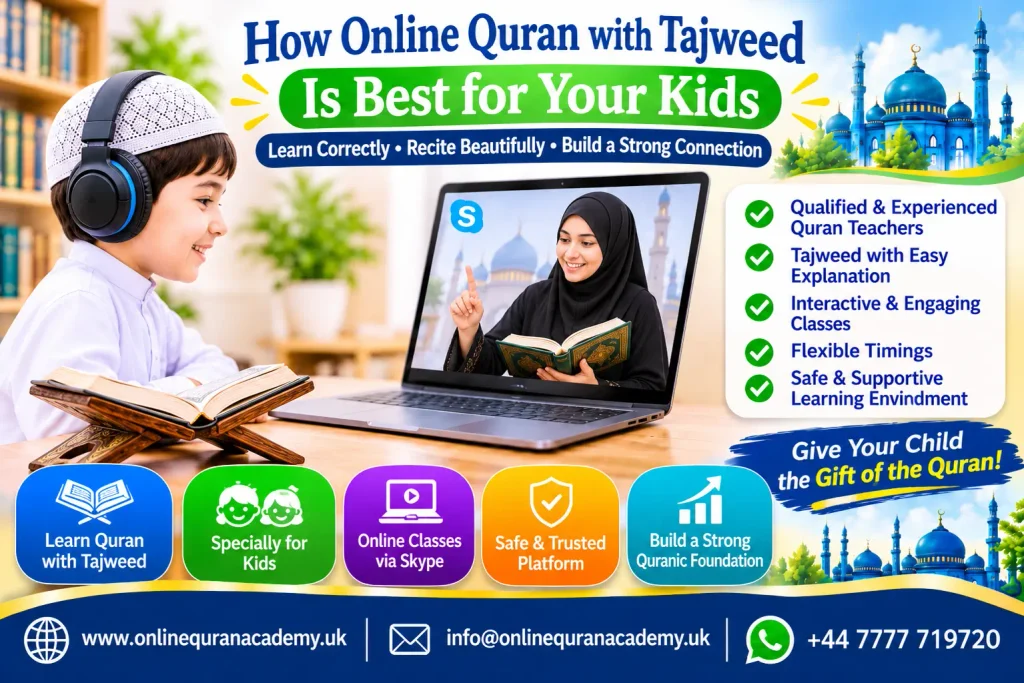
Online Quran with Tajweed is an effective way to help children develop correct Quranic pronunciation, improve their recitation and build a meaningful connection with the Holy Quran from an early age. For Muslim families in the UK, online Quran education offers the opportunity to learn from qualified teachers without travelling to a physical learning centre. Children can attend personalised lessons from home, practise at their own pace and receive individual attention that supports their learning journey.
Every parent wants their child to read the Quran correctly, understand its importance and develop a lifelong love for Islamic learning. However, balancing school, homework, extracurricular activities and family responsibilities can make traditional Quran lessons difficult to organise. Online Quran classes provide a flexible alternative that allows parents to arrange lessons around their children’s daily routines.
At Online Quran Academy UK, children can access personalised Quran education through live one-to-one lessons covering Arabic reading, Noorani Qaida, Quran recitation, Tajweed and memorisation. The objective is to help every child progress according to their current ability rather than forcing them to follow the same learning speed as everyone else.
In this comprehensive guide, we will explore why online Quran learning with Tajweed is beneficial for children, how online lessons work, what children learn at different stages, how parents can choose suitable teachers and how to make Quran education enjoyable and consistent.
What Is Online Quran with Tajweed for Kids?
Online Quran with Tajweed for kids refers to live Online Quran lessons delivered through internet-based communication platforms, where children learn Quran reading and pronunciation under the guidance of a qualified teacher.
Unlike recorded videos or independent learning applications, live Online Quran Classes allow children to interact directly with their teachers. They can read Arabic letters, practise Quranic verses, ask questions and receive corrections during the lesson.
Tajweed is the set of rules that governs the correct pronunciation of Quranic letters and the proper characteristics of Quranic recitation. It helps learners understand how letters should be articulated, when sounds should be extended and how particular pronunciation rules should be applied.
For young learners, Tajweed should be introduced gradually according to their reading ability.
A complete beginner may first need to recognise Arabic letters and understand their sounds before studying more advanced recitation rules. A child who already reads the Quran may benefit from focused Tajweed instruction to improve fluency and correct recurring mistakes.
Online Quran education can therefore accommodate children at different learning stages.
Why Online Quran with Tajweed Is Best for Your Kids
Choosing an appropriate Quran learning method can influence a child’s confidence, consistency and overall educational experience.
Online learning combines direct teacher interaction with the convenience of studying from home. Here are the most important reasons why parents consider this approach.
1. Children Learn Correct Quran Pronunciation from the Beginning
Correct pronunciation is one of the most important foundations of Quran education.
Arabic contains letters that may sound unfamiliar to children who primarily speak English. Some letters have similar sounds but different articulation points. Without proper guidance, children may develop pronunciation habits that become difficult to correct later.
A qualified Tajweed teacher can demonstrate how individual letters should be pronounced and allow children to repeat them until they become more familiar with the sounds.
For example, children gradually learn to distinguish between letters such as:
- س (Seen)
- ص (Saad)
- ت (Taa)
- ط (Taa with emphatic pronunciation)
- ح (Haa)
- ه (Haa)
The teacher listens carefully and explains the differences through practical examples.
This approach helps children develop a stronger understanding of Arabic pronunciation rather than simply memorising letter names.
2. Personalised One-to-One Quran Learning
One of the biggest advantages of online Quran classes is individual attention.
In a large group, some children may feel uncomfortable asking questions or requesting additional explanations. Others may need more time to understand a particular lesson.
One-to-one online Quran classes allow the teacher to focus on a single learner.
The teacher can:
- Identify the child’s reading level.
- Recognise pronunciation difficulties.
- Adjust lesson speed.
- Repeat challenging words.
- Introduce suitable Tajweed rules.
- Monitor learning progress.
- Provide revision exercises.
For example, if a child struggles with Makharij, the teacher can spend additional time practising articulation points rather than immediately moving to another topic.
This personalised approach is particularly helpful for beginners and children who need additional pronunciation practice.
3. Flexible Quran Classes Around UK School Timetables
Children in the UK have busy daily schedules.
School attendance, homework, sports, family activities and other commitments can make it difficult to follow a fixed Quran learning timetable.
Online Quran lessons allow parents to discuss suitable class times according to their family routines and tutor availability.
Children may be able to attend lessons during:
- After-school hours.
- Early evenings.
- Weekends.
- Suitable morning hours.
- School holidays.
This flexibility helps parents establish a more consistent learning routine.
However, scheduling should always consider the child’s energy and concentration. A lesson immediately after a tiring school day may not be ideal for every child.
A comfortable timetable is more valuable than simply arranging the maximum possible number of lessons.
4. A Comfortable Learning Environment at Home
Some children feel nervous when they enter an unfamiliar classroom or meet a new teacher.
Learning from home can make the initial experience more comfortable.
Children can sit in a familiar environment, use their own learning materials and communicate with their teacher without the pressure of a large classroom.
Parents can also remain nearby, observe lessons and help younger children manage their learning equipment.
A quiet study area, reliable internet connection and suitable device can make the experience more productive.
5. Children Receive Immediate Feedback
Reading the Quran without correction may allow pronunciation mistakes to become repeated habits.
In live online lessons, a teacher can listen to the child’s recitation and correct mistakes as they occur.
For example, a teacher may notice that a child:
- Confuses two Arabic letters.
- Does not pronounce a letter from its correct articulation point.
- Extends a sound incorrectly.
- Misses a required nasal sound.
- Reads too quickly.
- Does not observe an appropriate stopping point.
The teacher can demonstrate the correct recitation and ask the child to repeat the relevant word or verse.
This immediate feedback makes online Quran education more interactive than learning exclusively through recorded lessons.
6. Individual Learning Speeds Reduce Unnecessary Pressure
Every child learns differently.
Some children recognise Arabic letters quickly but need additional pronunciation practice. Others understand basic Tajweed rules but require more time to apply them during Quran recitation.
A good teacher should not compare children or expect everyone to complete a lesson within the same period.
Instead, lessons should be adjusted according to:
- Age and attention span.
- Previous Quran learning experience.
- Arabic reading ability.
- Pronunciation accuracy.
- Confidence.
- Regular practice.
This encourages children to develop their skills without feeling discouraged by unrealistic expectations.
7. Greater Opportunities to Learn from Qualified Teachers
Families may not always have access to a suitable local Quran teacher, particularly when they require a specific language or female tutor.
Online Quran education gives parents access to a wider selection of teachers.
At Online Quran Academy UK, families can explore male and female Quran tutors and discuss their learning requirements before choosing a suitable arrangement.
Parents should always ask about a teacher’s Quran education, Tajweed knowledge, Ijazah where relevant, teaching experience and ability to communicate with children.
A qualification alone does not guarantee that somebody can teach young learners effectively. Patience, communication and practical teaching skills matter too.
How Tajweed Helps Children Develop Better Quran Recitation
Tajweed is not simply about making Quran recitation sound beautiful. It provides the rules and principles that guide correct pronunciation.
Children who develop a foundation in Tajweed can become more aware of the sounds, characteristics and reading patterns of Quranic Arabic.
Here are some important areas they gradually learn.
Understanding Makharij (Articulation Points)
Makharij refers to the points from which Arabic letters are articulated.
Some letters originate from the throat, others from the tongue, lips or nasal passage.
Children learn to recognise these articulation points through listening, demonstration and repeated practice.
Correct Makharij is particularly important because certain Arabic letters can sound similar to beginners.
Learning Sifaat (Characteristics of Letters)
Sifaat refers to the characteristics of Arabic letters.
These characteristics help distinguish letters that may share similar articulation points.
Children gradually learn how particular letters should be pronounced, including differences in heaviness, lightness and other sound qualities.
Understanding Noon Saakin and Tanween
Noon Saakin and Tanween are important topics in Tajweed.
Children gradually become familiar with their associated rules:
- Izhaar.
- Idghaam.
- Iqlaab.
- Ikhfaa.
Rather than memorising names without understanding their application, children should practise identifying these rules within actual Quranic verses.
Learning Meem Saakin Rules
Meem Saakin has three commonly taught rules:
- Ikhfaa Shafawi.
- Idghaam Shafawi.
- Izhaar Shafawi.
A teacher can demonstrate these rules through Quranic examples and guided recitation.
Understanding Madd (Elongation)
Madd concerns the elongation of particular sounds during Quran recitation.
Children learn that different types of Madd have different requirements and should be applied correctly.
The teacher introduces these concepts gradually so that young learners are not overwhelmed by technical terminology.
Learning Qalqalah
Qalqalah is a pronunciation characteristic associated with five Arabic letters:
ق، ط، ب، ج، د
Children practise recognising these letters and producing the appropriate sound when the rule applies.
Practical examples are essential because understanding the definition alone does not develop accurate recitation.
Understanding Waqf (Stopping Rules)
Waqf refers to stopping during Quran recitation.
Children gradually learn to recognise stopping signs and understand where pausing or continuing is appropriate.
This helps develop more controlled and meaningful reading.
Parents can explore the online Quran Tajweed classes offered by Online Quran Academy UK to understand the structured approach to learning basic and applied Tajweed.

What Is the Best Age for Children to Start Learning the Quran Online?
There is no single perfect age for every child.
Some children may show readiness around four years old, while others benefit from starting when they are five or six.
The important factor is not age alone but the child’s ability to listen, follow simple instructions, recognise visual information and participate in short learning activities.
Ages 4–5: Introduction to Arabic Letters
At this stage, lessons should be short, friendly and suitable for a young child’s attention span.
Children can begin learning:
- Arabic alphabet recognition.
- Basic letter sounds.
- Listening and repeating.
- Simple Arabic pronunciation.
- Familiarity with Quran learning materials.
Teachers should use encouragement and repetition rather than expecting young children to master difficult concepts immediately.
Ages 6–8: Noorani Qaida and Basic Reading
Children at this stage can gradually develop stronger reading foundations.
Their lessons may include:
- Arabic letters with vowel signs.
- Joined letters.
- Basic reading combinations.
- Short Quranic words.
- Introduction to simple Tajweed concepts.
The Noorani Qaida course can provide an appropriate foundation for children who are new to Arabic reading.
Ages 9–12: Quran Reading and Tajweed Development
Children who have developed basic reading skills can progress towards more confident Quran recitation.
Their lessons may include:
- Quran reading and fluency.
- Makharij practice.
- Basic Tajweed rules.
- Correct pronunciation.
- Short surah revision.
- Introduction to memorisation.
Teachers should continue reviewing earlier lessons so that new information does not weaken previously learned skills.
Ages 13–16: Applied Tajweed and Advanced Learning
Older children can often engage with more detailed explanations of Quran recitation.
Depending on their ability, lessons may include:
- Applied Tajweed.
- Advanced pronunciation practice.
- Independent Quran reading.
- Hifz preparation.
- Revision planning.
- Selected Quranic vocabulary and meanings.
Age groups are only general guidance. A proper level assessment is more useful than assigning a course purely according to a child’s age.
The Learning Journey: From Noorani Qaida to Tajweed and Hifz
Parents sometimes wonder whether their children should start with Tajweed, Quran reading or memorisation.
The answer depends on their existing knowledge.
A structured learning pathway usually follows these stages.
Stage 1: Arabic Alphabet Recognition
Children begin by recognising Arabic letters and learning their basic sounds.
The objective is to establish familiarity with the Arabic alphabet.
Stage 2: Noorani Qaida
Noorani Qaida introduces children to vowel signs, joined letters and basic reading combinations.
It helps learners develop the foundational skills needed to read Quranic Arabic.
Stage 3: Quran Reading (Nazra)
Once children develop sufficient reading ability, they can begin reading directly from the Quran.
At this stage, teachers focus on accuracy, fluency and correcting recurring pronunciation errors.
Stage 4: Basic and Applied Tajweed
Children gradually study Tajweed principles and practise applying them during recitation.
This includes Makharij, Sifaat, Madd, Noon Saakin, Tanween, Meem Saakin and other relevant rules.
Stage 5: Quran Memorisation (Hifz)
Children who wish to memorise the Quran can begin an appropriate Hifz programme when their reading foundation is sufficiently developed.
Memorisation should include regular revision, not simply learning new verses.
Explore the online Quran memorisation programme for more information about structured Quran memorisation.
How Do Online Quran Classes for Kids Actually Work?
Parents who have never enrolled their children in online Quran lessons may be unfamiliar with the teaching process.
Fortunately, the basic arrangement is straightforward.
Step 1: Registration and Initial Discussion
Parents share their child’s age, current Quran reading ability, preferred tutor and suitable lesson times.
Step 2: Learning Level Assessment
A teacher checks whether the child needs Arabic alphabet instruction, Noorani Qaida, Quran reading or Tajweed.
Step 3: Teacher Selection
The academy helps arrange a suitable teacher according to the child’s learning requirements and the family’s preferences.
Step 4: Live One-to-One Lessons
Children attend interactive lessons through an agreed online platform, such as Microsoft Teams, Google Meet or Skype.
Step 5: Regular Revision and Feedback
The teacher reviews previous lessons, corrects mistakes and guides the child towards the next learning objectives.
Step 6: Parent Communication
Parents can discuss progress, attendance, difficulties and future learning goals with the academy.
Online Quran Academy UK offers a three-day free trial, allowing families to experience the teaching arrangement before choosing a regular plan.
Parents can visit the online Quran classes for kids page to explore the programme.
How to Choose the Best Online Quran Teacher for Your Child
Choosing the right teacher is one of the most important decisions parents make.
A teacher influences not only a child’s pronunciation but also their attitude towards Quran education.
Here are seven factors worth considering.
1. Check Quran and Tajweed Qualifications
Ask about the teacher’s educational background and experience in Quran recitation.
If the teacher claims to hold an Ijazah, ask about its type, the recitation tradition or transmission it covers and whether it is relevant to the course being taught.
2. Look for Experience Teaching Children
Teaching adults and teaching young children require different approaches.
A good children’s Quran teacher understands how to explain unfamiliar sounds, maintain attention and encourage learners without creating unnecessary pressure.
3. Consider Communication Skills
If your child primarily speaks English, choose a teacher who can explain basic concepts in English or another language your child understands.
Parents may also discuss Urdu or Arabic language support where appropriate.
4. Ask About Individual Attention
Find out whether the teacher listens to your child read during the lesson and provides individual pronunciation corrections.
A lesson should involve active recitation, not simply listening to the teacher for the entire session.
5. Consider Female Quran Teachers
Some families prefer a female Quran teacher for their daughters or younger children.
Parents should be able to discuss this preference before lessons begin.
You can explore the female Quran tutor programme for more information.
6. Request Progress Feedback
Ask how the teacher measures improvement.
Useful feedback should explain what the child has learned, which areas need more attention and what the next learning objectives are.
7. Attend a Trial Lesson
A trial lesson gives parents an opportunity to assess the teaching style.
Observe whether the teacher is patient, listens carefully, corrects pronunciation and communicates appropriately with the child.
Are Online Quran Classes Safe for Children?
Online safety should be a priority whenever children participate in internet-based education.
Online Quran learning can provide a convenient educational environment, but parents should not assume that every online class is automatically safe.
A responsible arrangement requires parental involvement, suitable supervision and clear communication.
Consider the following precautions:
- Confirm the teacher’s identity before lessons begin.
- Ask about teacher recruitment and background-check procedures.
- Use an approved learning platform.
- Keep lesson links private.
- Ensure a parent or guardian can observe or supervise sessions.
- Avoid unnecessary private communication between teachers and children.
- Understand whether lessons are recorded and how recordings are stored.
- Ask how personal information is collected and protected.
- Establish a clear process for reporting concerns.
For younger children, a parent should ideally remain in the room during lessons.
Older children should also have appropriate supervision and clear boundaries.
UK parents can consult the NSPCC online safety guidance for additional advice about protecting children online.
Parents can also learn about the Disclosure and Barring Service and understand what different types of checks do and do not establish.
A DBS check should not be treated as a complete guarantee of someone’s suitability or safety, particularly when considering overseas teaching arrangements.
How Parents Can Help Children Improve Quran Recitation at Home
Online lessons are important, but children’s progress also depends on what happens between classes.
Parents do not need to be Quran teachers to support their children’s learning.
Small, consistent activities can make a meaningful difference.
Establish a Regular Practice Routine
Choose a convenient daily time for Quran revision.
For younger children, five minutes of focused practice may be more productive than a long session that exceeds their attention span.
Older children may gradually increase their practice time.
Listen Without Creating Pressure
Ask your child to read a previously studied passage.
Listen attentively and encourage them when they pronounce words correctly.
If you are unsure about a Tajweed correction, allow the teacher to explain it rather than introducing conflicting instructions.
Use the Same Learning Material
Children benefit from consistency.
Using the same Qaida, Quran edition and lesson materials can help them recognise their previous work and revise more effectively.
Celebrate Small Achievements
Recognise improvements such as reading a difficult word correctly, remembering a Tajweed rule or completing a revision target.
Positive encouragement can help children develop confidence.
Communicate with the Teacher
Ask for occasional updates about:
- Reading fluency.
- Pronunciation.
- Tajweed application.
- Revision habits.
- Areas requiring additional support.
Parents and teachers working together can create a more supportive learning environment.
Common Mistakes Parents Should Avoid When Teaching Quran to Children
Even well-intentioned parents can sometimes make mistakes that affect a child’s learning experience.
Understanding these problems can help families make better decisions.
Starting Advanced Tajweed Too Early
Children who are still learning Arabic letters may find advanced Tajweed terminology confusing.
Build the reading foundation first, then introduce rules gradually.
Expecting Every Child to Learn at the Same Speed
Comparing siblings or classmates can reduce confidence.
Each child should have realistic learning goals based on their own progress.
Choosing a Teacher Only Because of Low Fees
Affordability matters, but price should not be the only deciding factor.
Teaching qualifications, communication, lesson quality and child safeguarding are equally important considerations.
Ignoring Daily Revision
A child may understand a lesson during class but forget it without practice.
Short revision sessions help reinforce previously learned material.
Rushing Children into Hifz
Memorisation should be introduced according to the child’s reading ability, interest and readiness.
A strong foundation in Quran reading and revision makes memorisation more manageable.
Allowing Lessons to Become Boring
Children need opportunities to participate.
Teachers should use repetition, questions, demonstrations, short exercises and positive encouragement.
Not Monitoring Learning Progress
Parents should periodically review what their child has learned.
Without clear progress discussions, it can become difficult to identify whether the current teaching approach is working.
Online Quran Classes vs Traditional Quran Classes: Which Is Better?
Both online and traditional Quran education can provide valuable learning experiences.
The better option depends on the child’s needs, family circumstances and available teaching quality.
| Factor | Online Quran classes | Traditional classes |
|---|---|---|
| Learning location | From home | Physical learning centre |
| Travel | No regular travel | Usually requires travel |
| Timetable | Flexible arrangements | Often fixed |
| Individual attention | Available through one-to-one lessons | Depends on class size |
| Teacher selection | Wider geographical choice | Often locally available |
| Parent supervision | Easier to observe from home | Depends on centre arrangements |
| Social interaction | Primarily teacher-led | More opportunities for group interaction |
| Technology | Requires internet and a suitable device | Usually no internet required |
Online learning is especially useful for families who need flexible schedules or cannot easily access suitable local teachers.
Traditional learning may be preferable for children who benefit strongly from group interaction and in-person classroom routines.
Parents should focus on educational quality rather than assuming that one learning method is universally superior.
How Long Does It Take for a Child to Learn Quran with Tajweed?
There is no guaranteed timeline for mastering Quran reading or Tajweed.
The learning period depends on several factors, including:
- Starting reading level.
- Age and concentration.
- Number of weekly lessons.
- Teacher’s teaching method.
- Daily revision.
- Pronunciation difficulties.
- Consistency.
A child who already reads the Quran may need a different programme from a complete beginner.
Similarly, learning basic Tajweed rules and applying them consistently during recitation are two different stages.
Parents should ask the teacher to establish realistic learning milestones rather than relying on promises of completing a course within an unusually short period.
The purpose of Quran education should be lasting understanding and accurate recitation, not simply finishing lessons quickly.
What Equipment Does Your Child Need for Online Quran Learning?
One of the advantages of online Quran classes is that families do not need complicated equipment.
Most children can begin with:
- A laptop, desktop computer or suitable tablet.
- A reliable internet connection.
- A microphone and speakers or headphones.
- A quiet learning area.
- A Quran or Noorani Qaida, depending on the child’s level.
- Access to the agreed video learning platform.
A larger screen may be more comfortable for younger children because it makes Arabic letters and Quranic text easier to see.
Parents should also check microphone and internet quality before lessons begin.
Why Choose Online Quran Academy UK for Your Child’s Quran Education?
Finding a suitable Quran learning programme involves more than selecting an online timetable.
Parents need a learning environment where their children receive individual attention, appropriate instruction and regular guidance.
Online Quran Academy UK provides personalised online Quran education for children, adults, sisters and beginners.
Its learning programmes include Quran reading, Tajweed, Noorani Qaida, Quran memorisation and Islamic studies.
Here are some of the features families can explore.
Qualified Male and Female Quran Tutors
Families can discuss their preferred teacher and learning requirements.
The academy provides male and female tutors with Quran and Islamic education backgrounds.
Personalised One-to-One Lessons
Individual lessons allow teachers to focus on each child’s current reading level, pronunciation and learning objectives.
Structured Quran Learning Programmes
Children can begin with Noorani Qaida and progress towards Quran reading, Tajweed and memorisation according to their ability.
Flexible UK Learning Arrangements
Parents can discuss suitable lesson times around school, homework and family commitments.
Multiple Language Support
English, Urdu and Arabic support is available, with other language requirements discussed according to tutor availability.
Three-Day Free Trial
Parents can experience the academy’s teaching arrangement before selecting a regular learning plan.
To learn more about the academy’s teachers, educational approach and programmes, visit the About Online Quran Academy UK page.
Frequently Asked Questions About Online Quran with Tajweed for Kids
1. Is online Quran with Tajweed suitable for young children?
Yes. Online Quran lessons can be suitable for young children when the teaching approach is adjusted to their age, attention span and reading ability. Beginners can start with Arabic letters and Noorani Qaida before progressing towards Quran reading and Tajweed.
2. Can a child learn Quran online without knowing Arabic?
Yes. Children do not need previous Arabic language knowledge to begin learning Quran reading. A teacher can introduce Arabic letters, their sounds, vowel signs and basic reading combinations step by step.
3. What is the best age to start online Quran classes?
Some children may be ready around four years old, while many begin between five and six. Readiness, concentration and the ability to participate in a short lesson are more important than following a fixed age.
4. How many online Quran lessons should children take each week?
The appropriate frequency depends on the child’s age, learning goals and available practice time. Parents can discuss a suitable timetable with the teacher. Regular lessons combined with short home revision sessions generally support consistency.
5. Can children learn Tajweed through online classes?
Yes. Live online classes allow teachers to demonstrate pronunciation, listen to children’s recitation and correct mistakes. A suitable programme should combine explanations with practical Quran reading rather than focusing only on memorising Tajweed terminology.
6. Is Noorani Qaida necessary before learning Tajweed?
For complete beginners, Noorani Qaida or another suitable Arabic reading foundation is usually a helpful starting point. Children who already read the Quran may be able to begin Tajweed instruction after an assessment.
7. Are female Quran teachers available for girls?
Yes. Online Quran Academy UK offers female Quran tutors, and parents can discuss their preference when arranging lessons.
8. Can parents monitor online Quran lessons?
Parents should be able to supervise their children’s learning and understand how lessons are conducted. For younger children, remaining in the room is a sensible precaution.
9. How can I know whether my child is improving?
Look for measurable improvements in letter pronunciation, reading fluency, recognition of Tajweed rules, confidence and independent reading. Ask the teacher for regular feedback and specific learning targets.
10. Can my child learn Hifz after studying Tajweed?
Yes. Children can progress towards Quran memorisation when their reading foundation and learning readiness are appropriate. A structured Hifz plan should include regular revision of previously memorised verses.
11. Does online Quran learning work for children who speak English at home?
Yes. Children who primarily speak English can begin with Arabic letter recognition and pronunciation. Teachers who can explain concepts in English may make the learning process easier for beginners.
12. What happens if my child struggles with pronunciation?
The teacher should identify the difficult letters or sounds, demonstrate their correct pronunciation and provide repeated practice. Some sounds require more time and individual attention, so parents should avoid rushing the child.
13. Do online Quran classes require expensive equipment?
No. A suitable laptop, computer or tablet, reliable internet connection and working microphone are generally enough to get started.
14. Does Online Quran Academy UK offer a free trial?
Yes. Online Quran Academy UK advertises a three-day free trial. Parents can use this opportunity to discuss their child’s current level, meet a suitable tutor and understand the teaching arrangement.
Final Thoughts: Give Your Child the Best Start with Online Quran with Tajweed
Providing children with a strong Quranic foundation is a valuable responsibility for Muslim parents. The right learning environment can help them develop accurate pronunciation, confidence, discipline and a lasting connection with the Holy Quran. Online Quran with Tajweed offers a flexible and personalised approach that allows children to learn from home while receiving direct guidance from qualified teachers. By choosing an appropriate teacher, following a structured learning pathway, practising regularly and remaining involved in their progress, parents can help their children develop their recitation skills gradually and confidently. If you are looking for a supportive starting point, explore Online Quran Academy UK’s children’s Quran programmes and arrange a three-day free trial to discover a suitable learning path for your child.
